Last May (2009) our second car threw a timing belt which sucked into the engine and effectively destroyed the vehicle. Although we are a family of 5, with one student in school 25 miles away due to custody issues, we have never replaced that car.
Kermit was wrong: It is "easy being green!" If we make ourselves aware that we have choices, many earth-friendly alternatives require very little effort and give big payoffs. Here is one household's experiment in going Green, the easy way.
Last May (2009) our second car threw a timing belt which sucked into the engine and effectively destroyed the vehicle. Although we are a family of 5, with one student in school 25 miles away due to custody issues, we have never replaced that car.
UPDATE: Ended the bike-year (on the solstice) having driven 904 bike miles that I didn't ride in the car. See the prior post for the details on how you can become less of a car-rider . . . and for links to the Red Tag Your Car series.
It is interesting that last week, on Bike to Work Day, May 14, I logged an even 800 miles on my bike over the preceding 11 months. (I will probably hit 900 by the end of the school year, and may make an effort to hit the symbolic 1000 mile point.)
At this time (see item #2) I tend to view the need to ride in a car as a failure; of errand route planning, of ability to find a truly local option, of trying to squeeze too much to fast into a life on the road.
It's a fairly ancient and standard joke that in the world of Politically Correct Terminology a trash hauler is a "sanitary engineer." Despite that, it is actually true that how we name things does affect how we perceive them. Here are a few suggested alternative terms for things that just might help folks understand why the green version is important:
food." Try this term swap yourself, and suddenly organic food seems a lot more reasonable.
nature of human powered transportation in our cities and suburbs. I have taken to referring to "bike drivers" when discussing vehicular cyclists. Bike drivers have a right to use the road; bike drivers are serious vehicles, going places and doing things, not just sports enthusiasts out for a little ride. So, you might hear me say something like this:
Tomorrow I'll drive my bike to the market after work; because of the bike I'll have an easier time parking than most of the car riders making the same trip. I'll buy our favorite clean pasta and sauce to cook for a big group of folks, but will probably compromise and buy chemically grown dark chocolate for the dessert we are making, and dirty artichokes because the clean ones are currently out of stock. "
See what I mean? The need to buy chemically grown and dirty food over clean food is terribly reduced. In my revised paragraph, the patchouli-tinged aura associated with a fluffy bike ride to buy organic pasta is reduced, as is the whingeing and whining factor that comes of complaining that your store is out of organic vegetables. No one could blame you for griping about having to buy chemically grown food -- even though most people don't realize that's what they're eating already anyway!
Remember the advice of good old Humpty Dumpty:
'When I use a word,' Humpty Dumpty said, in a rather scornful tone,' it means just what I choose it to mean, neither more nor less.' 'The question is,' said Alice, 'whether you can make words mean so many different things.' 'The question is,' said Humpty Dumpty, 'which is to be master - that's all.'
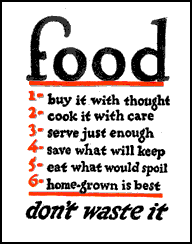
For me, Cooking with Care means using both sustainable and healthy cooking methods. The PTF
folks make use of a solar oven regularly -- which is beyond my personal commitment level. But we choose to use natural gas for our stove and oven, since it is a more efficient and less "carboniferous" (lower CO2) method for cooking than an electric range. If we ever had a surfeit of solar electricity on our hands it might make sense to use an electric range; but we only do 70-90% solar annually, so not yet.
I also like the common sense reminder Don't Waste It (food); that's a no brainer, of course, since trashing edible food costs the local household budget needlessly, but it also affects the larger ecosystem. Where a community or country is particularly profligate, the waste can really add up to a level that moves food production into a non-sustainable place.
The other half of waste, however -- at least in my mind -- comes down to what one does with the parts of the food one does not eat. Trimmings from vegetable preparation, for example. Th
e potato that went soft in the back of the bin. Even the green beans which no threat or entreaty could convince the three-year-old to eat. Can we avoid wasting them? You bet!
A small bin on the counter and simple compost bin in the yard or on an apartment patio (yes they do have a sealed compost bin for just such a situation) is a great way to reduce landfill mass and avoid wasting the excellent fertilizer and soil builders one might otherwise throw away. For a longer rant on composting, click here.
The final concept -- Homegrown is Best -- is both one of the easiest to achieve at some level and hardest to achieve at a significant level. But it is an excellent aspirational goal -- especially
since you know that the food is organic, definitely local and fair trade. More interestingly, I have found I am far less likely to be wasteful with food that I have grown. I know how long it took to get that bowl of broccoli or pan of fried potatoes, and you will see me turn positively miserly when it comes to using up food I have invested months of time in!
The other night a lady spoke at a meeting of our city Environmental Advisory Commission, calling herself an "uncommitted reusable bag user." She had come down to the City Council chambers to support a proposal to prohibit single-use plastic bags and place a disposal and education fee on single use paper bags.In all seriousness, the reusable bag would-buts fall into three major categories -- old habits, self-justification (not enough bags, too many needed), and embarrassment at looking like an enviro-loon. None are insurmountable. You know you have made it to the sustainable place when you make an unexpected stop, feel just a little upset that you had to take a plastic bag for something that you couldn't at least carry away without a bag!
NOVEMBER 28, 2007
We are a just one family trying to make the transition from an unsustainable lifestyle to a reasonable one, and this blog has chronicled some of our discoveries and experiences about the "easy" green things to do.
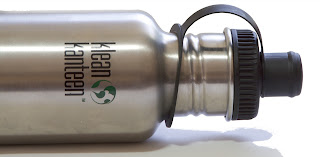
A while back, I wrote about giving up on plastic water bottles. Given our current rate of use, our cool reusable water bottles will have saved us $532 this year, and kept at least 1,825 plastic bottles from being created, or buried in the landfill.
year. At our local Trader Joe’s a case of bottled water the same size as our steel bottles works out to just over 29 cents per bottle. Thus, 1,825 x $0.29 = $532 in savings last year alone.
per bottle of water!
Here is an easy green exercise that handles several core greenie values all at once: compost your kitchen scraps.
on an apartment patio or car port without the need for ground contact. (Above, right, in neglected corner of the yard is our ground-contact composter and a handy "mixing rod.")


Clean, cold water. It's good stuff -- unless you pollute it or the greater environment by drinking it from a plastic bottle!
plastic water bottles. Although various mechanisms have been suggested for plastic byproducts leaching into bottled water (leaving bottles in hot cars, re-using plastic bottles), Snopes.com purports to have debunked these.
pollution and carbon overhead of all petroleum products. Although a fraction of Plastic bottles are recycled, for every bottle that is reused there said to be the equivalent of 70 bottles of waste generated in the process. In addition, manufacturing plastics requires energy for each bottle; less energy per bottle than a steel one, for example, but not if the steel bottle is reused for its likely long lifetime.
disposable. Most plastic bottles end up in landfills, or worse, as non-degradable litter on the landscape or in our waterways. Again, the lifetime of a steel or even glass bottle is many times higher, and thus the embodied energy and pollution is many times lower, than using an equivalent number of plastic containers.
simple Arrowhead water). The folks at http://www.thebottledwaterstore.com/ boast that they are "[y]our source for unique high-quality bottled water products from around the world." And that means its value as a "green" commodity is further degraded by the addition of the carbon and oil use from its long distance ride to the market shelf.
washing is required from time to time, but not in the same way as if there were three day old fermented juice in them. (We have a two-year-old -- can you tell?)
I like coffee. I like it a lot. For years I have struggled with a Starbucks habit; my youngest was practically raised by baristas during my year off work as a stay-at-home dad, and by the age of one she knew the Starbucks logo well enough to exclaim with glee when we passed one. ( A "vente" cup of hot water makes a superb bottle warmer, by the way. See my old sbxfairtrade blog for handy hints if you are a stay at home dad.)Our friends over at the Bring Your Own Blog have already made the paper-cup point succinctly.
Which is Greener: Recycled Paper or Reusable?
There are several elements that must be considered to demonstrate that a reusable cup is better than a one-time use cup; most analysis take into consideration only one part of the multifaceted problem.
First is the embodied energy used in manufacturing the cup. A reusable cup will have more energy in its initial manufacture, and has to be washed, but over time it will save energy each over a similar number of paper or foam cups. One major factor is how the cup is washed: I rinse mine daily in warm tap water with a little soap; most studies assume the use of an energy hog dishwasher, albeit a relatively efficient energy hog as those things go.
On this basis, a reusable cup is relatively more energy efficient, at least if it is used repeatedly as intended.
Next is the issue of the resources used to create the cup. Plastic and foams come from oil. In generally, the fewer products made from oil, the better; whether you want to reduce the impact of oil drilling or think gas prices should be lower, less oil for cups is desirable. Paper cups, of course, come from trees, and in some cases a small percentage of post consumer recycled paper.
Then there is the disposal issue. Although paper cups may degrade over time, they take up landfill space in the meantime. And since many paper cups are, in fact, plastic coated, that degradation is not total, or quick. Neither plastic nor foam cups degrade in any reasonable amount of time (hundreds of years even in a landfill), and many spend time drifting around the landscape or floating around the ocean, where they kill wildlife.
Using an average of one disposable cup per day adds in the range of 25 lbs of solid waste to the landfill stream, and creates a larger pool of trash which can becomes "feral" and degrades the environment directly. (See, e.g., Report of the Green Restaurant Association and Report of the Starbucks Coffee Company / Alliance for Environmental Innovation Joint Task Force, p. 8-9.)
Finally, plastic and plastic coated food products have recently been implicated in all sorts of health problems, including reproductive defects in children born to women exposed to certain kinds of plastics. These plastics leach byproducts into our food, and into the environment for as long as they are around.
The Whole Story
Looking at the whole story, then, it is easy to see that the reusable to-go cup is a significant ecological improvement over one-use paper or plastic cups.
Reusable to-go cups also have a psychological advantage, too, by stepping away from the disposable mindset.
Which Reusable Cup?
So far the best reusable cup appears to be stainless steel. This metal is well known to be inert and resistant to just about anything you put in it. It washes up quick and easy by hand, and works equally well with hot and cold drinks. Many coffee outlets sell metal ones . . . to take it one step further, one can skip plastic water bottles too: One supplier of disposable cup and bottle replacements is the KleanKanteen company.
Plastic reusables are, at least, reusable; but since the use of plastic in food products is increasingly suspect, as noted above, a plastic mug cannot be recommended. Ceramic mugs have some of the lowest embodied energy, according to research studies, but for travel a steel mug is extremely durable and about the cleanest choice.
Paper, whether made from all virgin wood or some small percentage "post-consumer recycled content" still contains a lot of new tree material, and requires a reasonable amount of water and energy to make into each new cup, even with recycled content.
Three reasons to bring your own reusable cloth bags:
1. Plastic bags are mostly made from oil. The folks at MidAmerica Energy explain this in detail here or by clicking their picture, above. The fewer plastic bags we use the less we need oil from the Middle East, the less fossil fuel pollution we create, and the less energy we use manufacturing and transporting the darn things in the first place.
2. Some plastic shopping bags can be recycled. Most are not. Less than 10% of plastic bags are currently recycled. Some city trash collections, even though they accepted numbered plastics, do not do plastic shopping bags.
3. Plastic ends up in the landfill, and does not decompose (paper can be recycled and does decompose. Cloth can be reused thousands of times). It is also a notorious killer of marine animals, being washed down the storm drains and into the oceans.
Dealing With The Would-Buts
I would use cloth bags, but:
. . . I can never remember to bring them. Simple: Leave a nest of 4 or 5 bags in the trunk of your car, or the bike trailer you use for groceries. Put them all inside of one and roll 'em up. When you empty the bags in the house after shopping, put them *right* back in the car. Then they are always handy.
Bringing shopping bags has gotten to be so easy, that we take our TJ bags -- and reusable bags we have received elsewhere -- in to shop just about everywhere now. It may just be *one* little plastic bag -- but take a look at that counter over there, spinning by, one little bag (your little bag!) at time.
By the by, the cloth-bag habit is a good one to start now. Several cities have banned plastic shopping bags outright, and many more are looking at the idea seriously.
A word of warning about reusable bags, though: Be sure to save some for shopping. They are so handy, and so easy to grab, that they get used for all sorts of transporting jobs -- and you can and that all your shopping bags are otherwise engaged!
I Would But . . .
We’ll deal with these Top Ten Would-But excuses in future posts. For the moment it is enough to recognize a "would but" excuse for what it is – a temporary obstacle to be overcome. And once overcome, most of these would-buts seem terribly insubstantial.


Imagine if every single person on the planet invested 5% of their
energy in working toward a better self and a better world. I decided to try it,
since it's something I can do not just once, but every single day. These are the
stories of the little efforts I'm making while living my ordinary life. I'd love
to meet you along the way!
It turns out, maybe the easiest way to be green is to change your city's culture so that the city government helps you do it.
In the City of Pasadena, there are also a number of commissions -- staffed by citizen volunteers, not politicians -- to which you can take your ideas and concerns.
These quasi-insiders can often translate your issue into terms that the local government can work with effectively. They can also become a champion of your issue, and came at the issue from the inside, at the same time you work on the outside.
Some recent examples: The City of Pasadena recently became signatory to a UN document setting goals for combating global warming; and after citizen input the City dropped efforts to extend coal generation contracts for the local electric utility. ("No new coal" is now the official city policy(!).)
Bring your city around on key issues, and help yourself -- and thousands of your neighbors -- to an easy, Green future!